
Aeroplan Asia Sweet Spots: Save Up to 47.5K Points With a Stopover
Aeroplan’s best value within Asia is not limited to cheap short-haul awards. The more interesting opportunity comes from combining its distance-based award chart with a 5,000-point stopover.
When two flights are booked separately, each segment is priced according to its own distance band. When they are combined into one stopover itinerary, Aeroplan prices the itinerary based on the total flown distance, then adds 5,000 Aeroplan Points for the stopover.
That creates some unusual pricing gaps.
Some combinations can save as much as 47.5K Aeroplan Points in a real bookable itinerary, while others save only 5K. In a few cases, adding a stopover can even cost more than booking two separate awards.
This guide breaks down the complete mathematical combinations for Within Pacific Business Class partner awards and then compares them with routes I actually found through Aeroplan.
For the full Aeroplan award charts, partner airlines, pricing rules and stopover rules, see my Aeroplan Complete Guide.
⭐ Aeroplan Within Pacific Business Class Award Chart
This analysis focuses on fixed-price All Other Partners awards within the Pacific Zone.
| Total Flown Distance | Business Class | With Stopover |
|---|---|---|
| 0–1,000 miles | 20K | 25K |
| 1,001–2,000 | 30K | 35K |
| 2,001–5,000 | 52.5K | 57.5K |
| 5,001–7,000 | 72.5K | 77.5K |
| 7,001+ | 85K | 90K |
Adding a stopover costs:
+5,000 Aeroplan Points
The important comparison is therefore not simply whether a stopover costs only 5K.
Instead, compare:
Cost of booking A → B and B → C separately
versus:
Cost of A → B [Stopover] → C as one award
The difference between those two numbers is where the real Aeroplan sweet spots appear.
🧮 Aeroplan Pacific Stopover: Complete Mathematical Combinations
If we combine all five Within Pacific Business Class distance bands, we get the following possibilities.
| Rank | Segment A | Segment B | Combined Distance Band | Separate Awards | With Stopover | Savings |
|---|---|---|---|---|---|---|
| 1 | 7,001+ | 7,001+ | 7,001+ | 170K | 90K | 80K |
| 2 | 5,001–7,000 | 7,001+ | 7,001+ | 157.5K | 90K | 67.5K |
| 3 | 5,001–7,000 | 5,001–7,000 | 7,001+ | 145K | 90K | 55K |
| 4 | 2,001–5,000 | 2,001–5,000 | 2,001–5,000 | 105K | 57.5K | 47.5K |
| 5 | 2,001–5,000 | 7,001+ | 7,001+ | 137.5K | 90K | 47.5K |
| 6 | 2,001–5,000 | 5,001–7,000 | 7,001+ | 125K | 90K | 35K |
| 7 | 2,001–5,000 | 2,001–5,000 | 5,001–7,000 | 105K | 77.5K | 27.5K |
| 8 | 1,001–2,000 | 2,001–5,000 | 2,001–5,000 | 82.5K | 57.5K | 25K |
| 9 | 1,001–2,000 | 5,001–7,000 | 5,001–7,000 | 102.5K | 77.5K | 25K |
| 10 | 1,001–2,000 | 7,001+ | 7,001+ | 115K | 90K | 25K |
| 11 | 0–1,000 | 0–1,000 | 0–1,000 | 40K | 25K | 15K |
| 12 | 0–1,000 | 1,001–2,000 | 1,001–2,000 | 50K | 35K | 15K |
| 13 | 0–1,000 | 2,001–5,000 | 2,001–5,000 | 72.5K | 57.5K | 15K |
| 14 | 0–1,000 | 5,001–7,000 | 5,001–7,000 | 92.5K | 77.5K | 15K |
| 15 | 0–1,000 | 7,001+ | 7,001+ | 105K | 90K | 15K |
| 16 | 2,001–5,000 | 2,001–5,000 | 7,001+ | 105K | 90K | 15K |
| 17 | 1,001–2,000 | 5,001–7,000 | 7,001+ | 102.5K | 90K | 12.5K |
| 18 | 0–1,000 | 0–1,000 | 1,001–2,000 | 40K | 35K | 5K |
| 19 | 1,001–2,000 | 2,001–5,000 | 5,001–7,000 | 82.5K | 77.5K | 5K |
| 20 | 0–1,000 | 5,001–7,000 | 7,001+ | 92.5K | 90K | 2.5K |
| 21 | 1,001–2,000 | 1,001–2,000 | 2,001–5,000 | 60K | 57.5K | 2.5K |
| 22 | 0–1,000 | 2,001–5,000 | 5,001–7,000 | 72.5K | 77.5K | −5K |
| 23 | 0–1,000 | 1,001–2,000 | 2,001–5,000 | 50K | 57.5K | −7.5K |
The 80K, 67.5K and 55K savings at the top of the table are mathematical possibilities, not necessarily practical routings.
The more useful question is:
Which of these mathematical combinations can actually be booked through Aeroplan?
I found four useful examples that demonstrate very different levels of stopover efficiency.
🔥 Sweet Spot #1: PER → SIN → TPE for 57.5K Business Class
The most interesting practical combination is:
2,001–5,000 + 2,001–5,000 → combined distance still ≤5,000 miles
The ideal situation is for both segments to fall roughly within:
2,001–2,499 miles
Each flight would individually fall into the 52.5K Business Class band, while their combined distance can still remain under 5,000 miles.
One real example is:
Perth PER → Singapore SIN [5-day stopover] → Taipei TPE
- PER → SIN: Singapore Airlines
- SIN → TPE: EVA Air
- Business Class: 57.5K Aeroplan Points
- Cash component in my search: CA$223
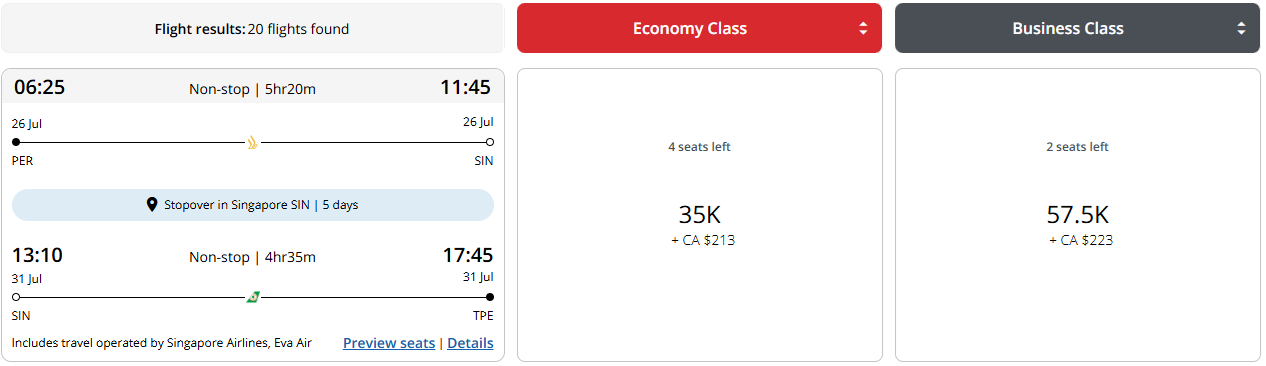
Booking the flights separately would cost:
| Booking | Aeroplan Points |
|---|---|
| PER → SIN | 52.5K |
| SIN → TPE | 52.5K |
| Separate total | 105K |
| Stopover itinerary | 57.5K |
| Savings | 47.5K |
That means:
105K → 57.5K
or a saving of approximately:
45.2%
This corresponds to #4 in the mathematical table.
While the theoretical combinations above it can produce larger savings, this is the strongest practical example I found: both individual flights cost 52.5K, yet the combined itinerary remains in the same 52.5K distance band.
🇯🇵 Sweet Spot #2: TPE → NRT → SIN for 57.5K Business Class
The second useful combination is:
1,001–2,000 + 2,001–5,000 → combined distance ≤5,000 miles
A real example is:
Taipei TPE → Tokyo NRT [10-day stopover] → Singapore SIN
- TPE → NRT: EVA Air
- NRT → SIN: Singapore Airlines
- Business Class: 57.5K Aeroplan Points
- Cash component in my search: CA$128
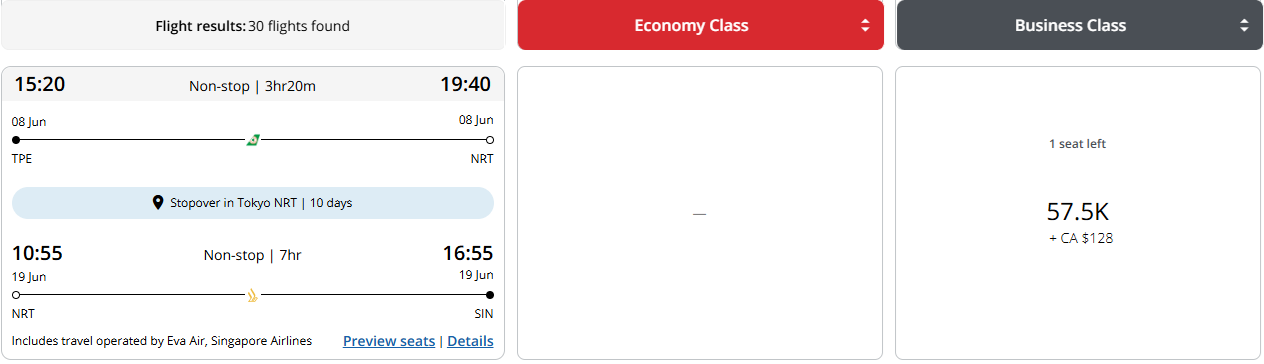
Booked separately:
TPE → NRT: 30K
NRT → SIN: 52.5K
Total:
82.5K
With the Tokyo stopover:
52.5K + 5K = 57.5K
Therefore:
82.5K → 57.5K
Savings:
25K Aeroplan Points
or approximately:
30.3%
This corresponds to #8 in the mathematical table.
The absolute savings are smaller than PER → SIN → TPE, but this can be a very practical itinerary for travelers starting in Taiwan:
Taipei → 10 days in Tokyo → Singapore
all on one Aeroplan award.
🇹🇼 Sweet Spot #3: OKA → TPE → HKG for Only 25K Business Class
The third strategy takes advantage of Aeroplan’s cheapest Within Pacific distance band:
0–1,000 miles
A real example is:
Okinawa OKA → Taipei TPE [10-day stopover] → Hong Kong HKG
Both flights are operated by EVA Air.
Aeroplan showed:
- Economy: 13K
- Business: 25K
- Cash component: CA$109
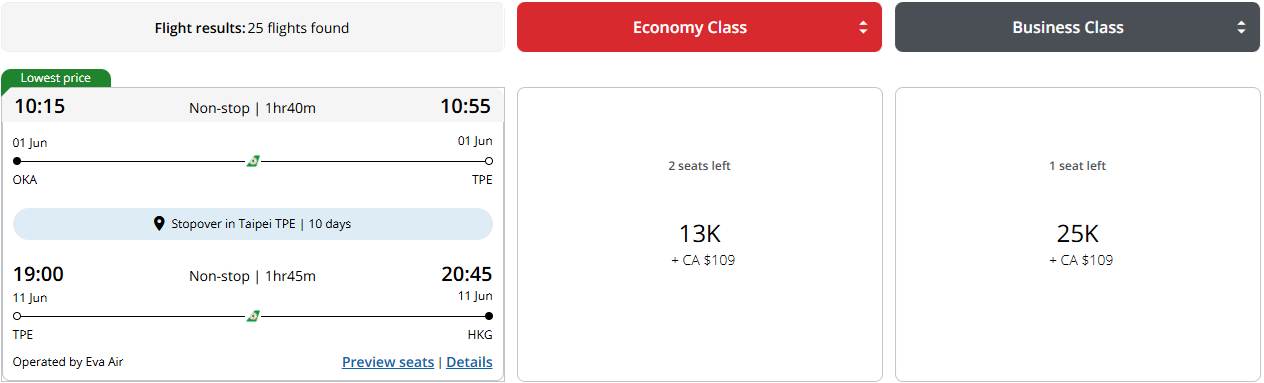
The important part is that:
Segment 1 <1,000 miles
Segment 2 <1,000 miles
and:
Combined distance <1,000 miles
If booked separately in Business Class:
20K + 20K = 40K
With a stopover:
20K + 5K = 25K
Therefore:
40K → 25K
Savings:
15K Aeroplan Points
or:
37.5%
This corresponds to #11 in the mathematical table.
The absolute savings are smaller than the PER example, but 25K for two Business Class flights plus a 10-day stopover in Taipei makes this an especially attractive short-haul strategy.
⚠️ A Less Efficient Example: TSA → GMP → HND Saves Only 5K
This itinerary shows why two individually cheap flights do not automatically create a great stopover sweet spot.
I found:
Taipei TSA → Seoul GMP [10-day stopover] → Tokyo HND
- TSA → GMP: EVA Air
- GMP → HND: ANA
- Business Class: 35K Aeroplan Points
- Cash component: CA$98
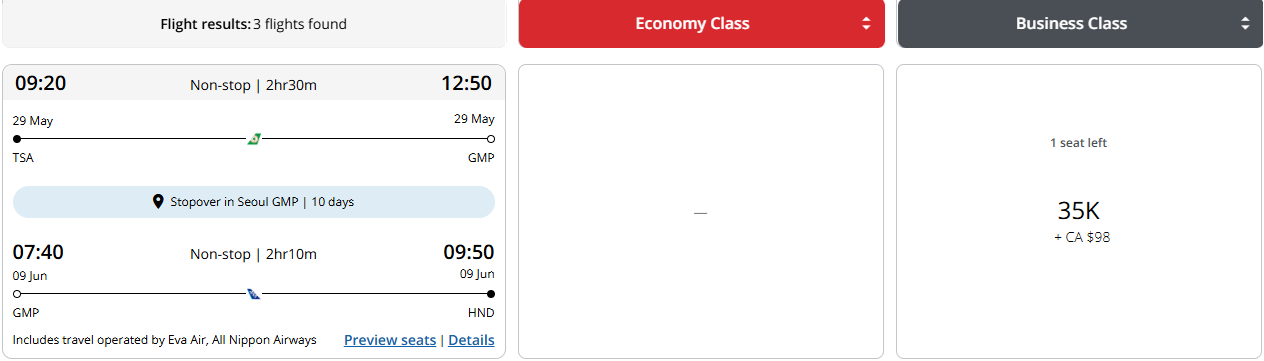
Both individual flights are:
under 1,000 miles
So if booked separately:
20K + 20K = 40K
However, their combined distance exceeds 1,000 miles.
The combined award therefore moves into the next band:
1,001–2,000 miles → 30K
Add the stopover:
30K + 5K = 35K
The result is only:
40K → 35K
Savings:
5K Aeroplan Points
or just:
12.5%
This corresponds to #18 in the mathematical table.
Compare it directly with OKA → TPE → HKG:
| Route | Individual Bands | Combined Band | Separate | Stopover | Savings |
|---|---|---|---|---|---|
| OKA → TPE → HKG | <1K + <1K | ≤1K | 40K | 25K | 15K |
| TSA → GMP → HND | <1K + <1K | 1–2K | 40K | 35K | 5K |
Both itineraries consist of two sub-1,000-mile flights.
The only major pricing difference is that the second itinerary crosses the 1,000-mile combined-distance threshold.
That reduces the savings from:
15K → 5K
This illustrates one of the most important Aeroplan stopover concepts:
Do not look only at the distance band of each individual flight. Always check which distance band the two flights enter after their distances are combined.
📊 Comparing the Four Real Aeroplan Stopover Examples
The four searches demonstrate four different levels of efficiency:
| Route | Segment Combination | Combined Band | Separate | Stopover | Savings |
|---|---|---|---|---|---|
| PER → SIN → TPE | 2–5K + 2–5K | ≤5K | 105K | 57.5K | 47.5K |
| TPE → NRT → SIN | 1–2K + 2–5K | ≤5K | 82.5K | 57.5K | 25K |
| OKA → TPE → HKG | <1K + <1K | ≤1K | 40K | 25K | 15K |
| TSA → GMP → HND | <1K + <1K | 1–2K | 40K | 35K | 5K |
The key is not a specific city pair.
It is finding two flights that are relatively expensive when priced individually but do not push the combined itinerary into the next distance band.
💡 How to Find Your Own Aeroplan Asia Sweet Spots
The complete mathematical table gives us three particularly useful patterns.
1. Look for Two Flights Around 2,001–2,499 Miles Each
This is the most valuable practical pattern.
Separately:
52.5K + 52.5K = 105K
If the combined distance remains:
≤5,000 miles
the stopover itinerary costs:
57.5K
Maximum savings:
47.5K
PER → SIN → TPE is a real example of this pattern.
2. Combine a 1,001–2,000-Mile Flight With a 2,001–5,000-Mile Flight
If the total remains under 5,000 miles:
Separate:
30K + 52.5K = 82.5K
With stopover:
57.5K
Savings:
25K
TPE → NRT → SIN is an example.
3. For Two Sub-1,000-Mile Flights, Watch the Combined Distance
There are two very different outcomes.
If:
A + B ≤1,000 miles
then:
40K → 25K
Savings:
15K
But if:
A + B >1,000 miles
then:
40K → 35K
Savings:
5K
That is exactly the difference between OKA → TPE → HKG and TSA → GMP → HND.
⚠️ An Aeroplan Stopover Is Not Always Cheaper
The bottom of the mathematical table reveals something even more important:
Adding a stopover does not automatically save points.
For example:
0–1,000 + 2,001–5,000
If the combined distance enters the 5,001–7,000-mile band:
Separate awards:
20K + 52.5K = 72.5K
Stopover award:
72.5K + 5K = 77.5K
You actually spend:
5K more
Another example:
0–1,000 + 1,001–2,000
If the combined itinerary exceeds 2,000 miles:
Separate:
20K + 30K = 50K
Stopover:
52.5K + 5K = 57.5K
You spend:
7.5K more
So:
A stopover is a pricing tool, not an automatic discount.
The real sweet spots come from exploiting the gaps between Aeroplan’s distance bands.
🔍 How to Search for an Aeroplan Stopover
Aeroplan stopovers can be searched directly on the Air Canada website.
Searching on a Desktop Computer
On the desktop version of Air Canada, change the search type to:
Multi-city / Stopover
and select:
Book with Aeroplan points
After entering your origin, final destination and travel date, click the Stopover option underneath the flight search fields.
Aeroplan will then display two additional fields:
- Stopover city
- Length of stopover
Enter the city where you want to stop and select the number of days before running the search.
Aeroplan will then search:
A → Stopover City → C
as a single stopover award.
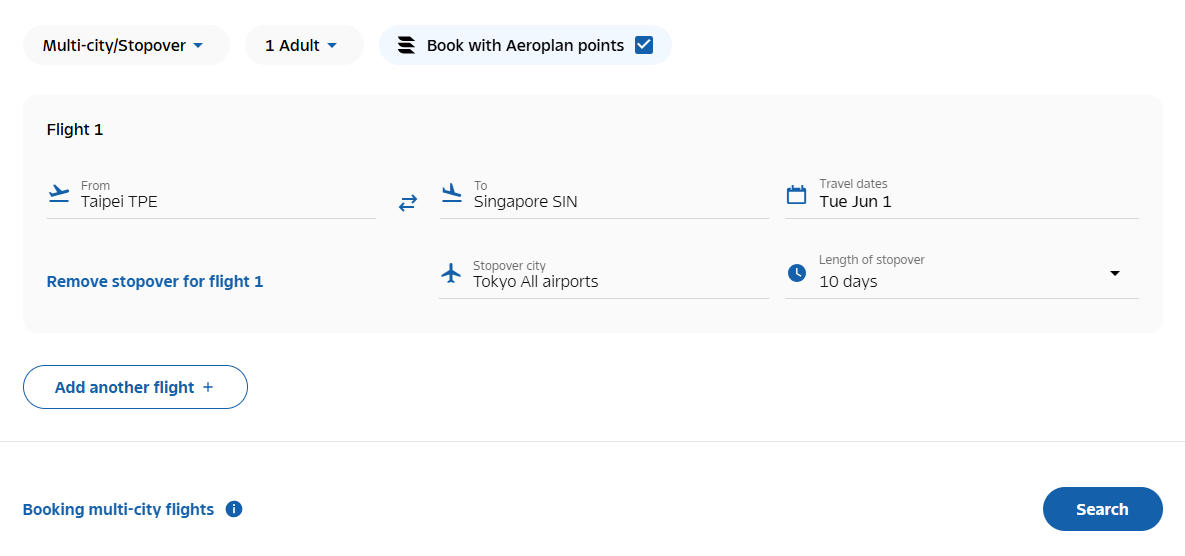
When looking specifically for sweet spots, I use this process:
| Step | What to Do |
|---|---|
| 1 | Find two flights with redeemable award availability |
| 2 | Calculate the flown distance of each segment |
| 3 | Determine each segment’s individual distance band |
| 4 | Calculate the price if booked separately |
| 5 | Add the two flown distances together |
| 6 | Determine the combined distance band |
| 7 | Add 5K for the stopover |
| 8 | Compare the separate and combined prices |
| 9 | Test the complete itinerary through Aeroplan |
The last step matters.
A mathematically valid combination does not guarantee that Aeroplan will allow the complete routing.
That is why the four examples above are based on actual Aeroplan search results rather than distance calculations alone.
🏁 Aeroplan Asia Sweet Spots: Final Takeaway
Aeroplan’s Within Pacific award chart becomes much more interesting when you combine:
Distance-based pricing × 5K stopover × staying within the right distance band
The four real examples demonstrate the difference:
PER → SIN → TPE: 105K → 57.5K, saving 47.5K
TPE → NRT → SIN: 82.5K → 57.5K, saving 25K
OKA → TPE → HKG: 40K → 25K, saving 15K
TSA → GMP → HND: 40K → 35K, saving only 5K
The most interesting practical mathematical combination is:
2,001–5,000 + 2,001–5,000 → combined distance still ≤5,000 miles
When a valid itinerary can be found:
105K → 57.5K
for a saving of:
47.5K Aeroplan Points
The most useful lesson, however, is not to memorize PER → SIN → TPE or any other specific route.
Instead:
Find award availability → calculate both segment distances → calculate the separate prices → calculate the combined distance band → add the 5K stopover → test the itinerary through Aeroplan.
Once you understand that process, you can use the same method to keep finding new Aeroplan Asia sweet spots as award availability changes.