
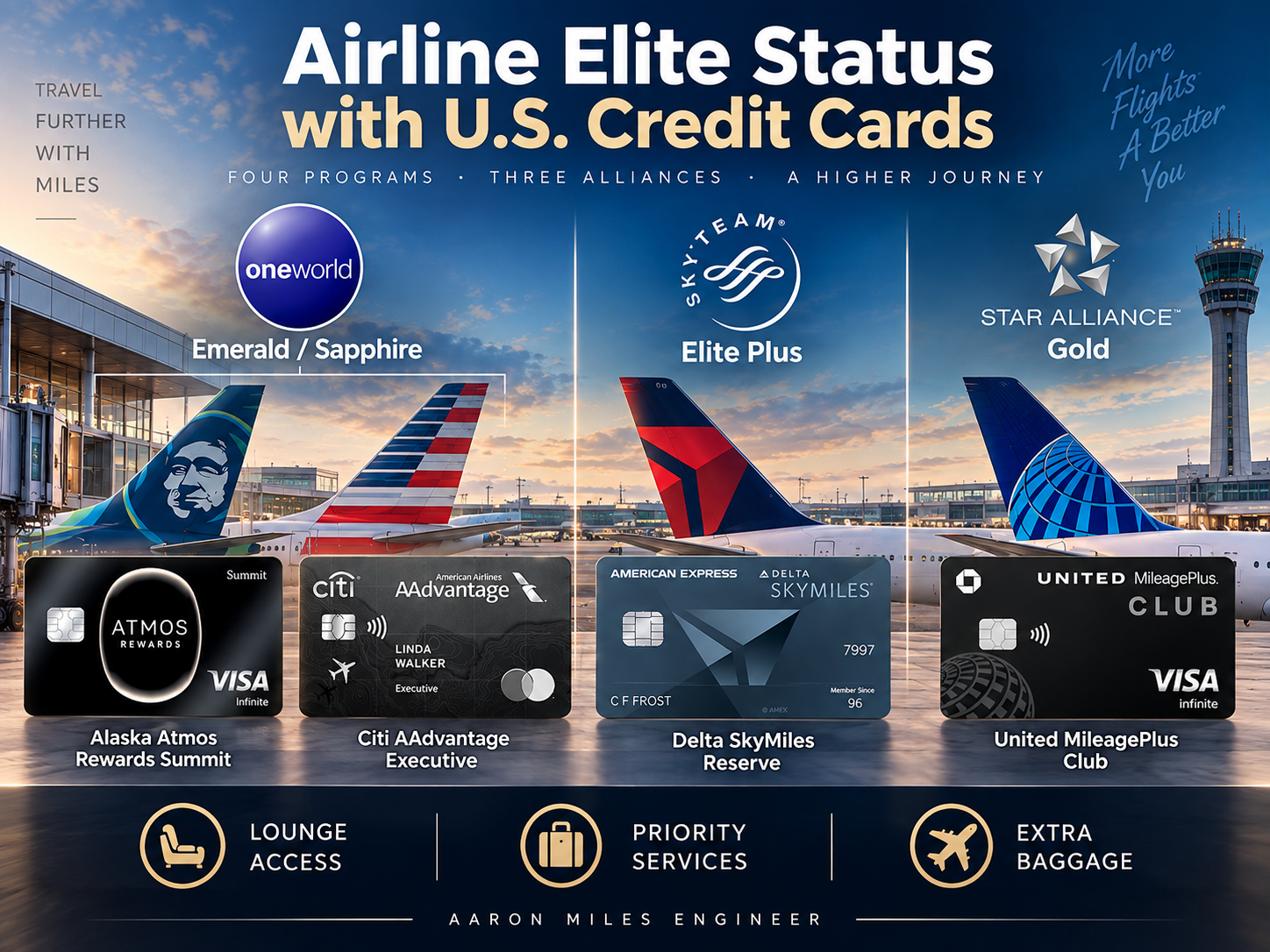


U.S. airline credit cards are not just useful for earning miles. For high spenders, they can also provide another valuable path:
Credit Card Spending → Airline Elite Status → Global Alliance Elite Status
This article compares four major U.S. airline loyalty programs:
- American AAdvantage → oneworld Sapphire / Emerald
- Atmos Rewards → oneworld Sapphire / Emerald
- Delta SkyMiles → SkyTeam Elite Plus
- United MileagePlus → Star Alliance Gold
Instead of comparing checked bags, lounge credits or companion certificates, this article answers one question:
How much credit card spending is required to earn useful airline alliance elite status?
Airline Alliance Elite Status Comparison
| Loyalty Program | Airline Elite Status | Alliance Status | Key Benefit |
|---|---|---|---|
| American AAdvantage | Platinum | oneworld Sapphire | Business Class Lounge Access |
| American AAdvantage | Platinum Pro | ⭐ oneworld Emerald | First Class Lounge Access |
| Atmos Rewards | Gold | oneworld Sapphire | Business Class Lounge Access |
| Atmos Rewards | Platinum | ⭐ oneworld Emerald | First Class Lounge Access |
| Delta SkyMiles | Gold Medallion | ⭐ SkyTeam Elite Plus | Business Class Lounge Access |
| United MileagePlus | Premier Gold | ⭐ Star Alliance Gold | Business Class Lounge Access |
oneworld is particularly interesting because there are two valuable tiers.
oneworld Sapphire provides access to eligible Business Class lounges, while oneworld Emerald adds access to eligible First Class lounges.
For Delta, the main target is Gold Medallion → SkyTeam Elite Plus. For United, it is Premier Gold → Star Alliance Gold.
Four Credit Card Elite Status Systems
| Loyalty Program | Representative Credit Card | Status Currency | Credit Card Earning |
|---|---|---|---|
| American AAdvantage | Citi AAdvantage Executive | Loyalty Points | US$1 ≈ 1 LP + LP Bonuses |
| Atmos Rewards | Atmos Rewards Summit | Status Points | US$2 = 1 SP + 10K Anniversary SP |
| Delta SkyMiles | Delta SkyMiles Reserve | MQD | US$10 = 1 MQD + 2,500 MQD Headstart |
| United MileagePlus | United Club Card | PQP | US$15 = 1 PQP + 1,500 Bonus PQP |
Because all four programs use different qualification systems, the easiest way to compare them is to convert everything into one number:
How much credit card spending is required?
oneworld Sapphire: Atmos vs American
American AAdvantage Platinum and Atmos Gold both provide oneworld Sapphire status.
| Credit Card | Target Status | Requirement | Required Spending |
|---|---|---|---|
| Atmos Rewards Summit | Atmos Gold | 40,000 SP | ⭐ US$60,000 |
| Citi AAdvantage Executive | AAdvantage Platinum | 75,000 LP | Approx. US$65,000 |
Atmos Rewards Summit provides 10,000 Anniversary Status Points each year.
That leaves:
40,000 − 10,000 = 30,000 SP
At US$2 = 1 Status Point:
US$60,000 → Atmos Gold → oneworld Sapphire
Citi AAdvantage Executive can use its Loyalty Point bonuses to reduce the effective spending requirement to approximately US$65,000.
If your goal is simply oneworld Sapphire, Atmos Rewards Summit has a slight advantage.
oneworld Emerald: American vs Atmos
For international travelers interested in higher-tier alliance benefits, oneworld Emerald is the more interesting comparison.
| Credit Card | Target Status | Requirement | Required Spending |
|---|---|---|---|
| Citi AAdvantage Executive | Platinum Pro | 125,000 LP | ⭐ Approx. US$105,000 |
| Atmos Rewards Summit | Atmos Platinum | 80,000 SP | US$140,000 |
For Atmos Rewards Summit:
80,000 SP − 10,000 Anniversary SP = 70,000 SP
At US$2 per Status Point:
US$140,000 → Atmos Platinum → oneworld Emerald
Citi AAdvantage Executive can use its Loyalty Point bonuses to reach AAdvantage Platinum Pro with approximately:
US$105,000 → Platinum Pro → oneworld Emerald
If oneworld Emerald is the primary objective, Citi AAdvantage Executive is therefore more efficient than Atmos Rewards Summit.
SkyTeam Elite Plus: Four Delta Strategies
Delta is the most flexible of the four programs.
Gold Medallion requires:
10,000 MQD → SkyTeam Elite Plus
Four Delta credit cards are eligible for 2,500 MQD Headstart each:
| Credit Card | MQD Headstart |
|---|---|
| Delta SkyMiles Platinum American Express Card | 2,500 MQD |
| Delta SkyMiles Platinum Business American Express Card | 2,500 MQD |
| Delta SkyMiles Reserve American Express Card | 2,500 MQD |
| Delta SkyMiles Reserve Business American Express Card | 2,500 MQD |
MQD Headstart can stack across different eligible card products.
If the remaining MQD is earned through a Delta Reserve card at US$10 = 1 MQD, there are four possible strategies:
| Eligible Delta Cards Held | MQD Headstart | Remaining MQD | Reserve Spending Required |
|---|---|---|---|
| 1 Card | 2,500 | 7,500 | US$75,000 |
| 2 Cards | 5,000 | 5,000 | US$50,000 |
| 3 Cards | 7,500 | 2,500 | US$25,000 |
| 4 Cards | 10,000 | 0 | ⭐ US$0 |
That creates a very unusual status strategy:
1 Card → US$75,000
2 Cards → US$50,000
3 Cards → US$25,000
4 Cards → US$0
Every route can lead to:
Gold Medallion → SkyTeam Elite Plus
US$0 here means no additional credit card spending is required to qualify for status. It does not mean the strategy has zero cost—the four cards still have their respective annual fees.
Holding all four cards is also not necessarily the best strategy. American Express commonly limits cardholders to approximately five Amex credit cards, so using four slots for Delta Platinum and Reserve personal/business cards can significantly reduce your ability to hold other valuable Amex credit cards, including Hilton Honors and Marriott Bonvoy cards.
For many high spenders, 2 Delta cards + US$50,000 spending or 3 Delta cards + US$25,000 spending may offer a better balance.
Star Alliance Gold: United Club Card
United Premier Gold requires:
10,000 PQP → Star Alliance Gold
United Club Card provides:
1,500 Card Bonus PQP
That leaves:
8,500 PQP
At:
US$15 = 1 PQP
The spending requirement becomes:
8,500 × US$15 = US$127,500
| Credit Card | Target Status | Bonus PQP | Required Spending |
|---|---|---|---|
| United Club Card | Premier Gold → ⭐ Star Alliance Gold | 1,500 | US$127,500 |
United has one additional requirement:
You must complete at least four qualifying flight segments operated by United or United Express during the qualification year.
The complete credit card strategy is therefore:
US$127,500 Spending + 4 Qualifying United Segments → Premier Gold → Star Alliance Gold
If you already fly United, eligible flights can also generate PQP and reduce the amount of credit card spending required.
Airline Alliance Elite Status Spending Comparison
This is the key table for the entire comparison.
| Strategy | Alliance Status | Required Spending | Additional Requirement |
|---|---|---|---|
| 4 Delta Cards | SkyTeam Elite Plus | ⭐ US$0 | Hold 4 eligible cards |
| 3 Delta Cards + Reserve Spending | SkyTeam Elite Plus | US$25,000 | Hold 3 eligible cards |
| 2 Delta Cards + Reserve Spending | SkyTeam Elite Plus | US$50,000 | Hold 2 eligible cards |
| Atmos Rewards Summit | oneworld Sapphire | US$60,000 | — |
| Citi AAdvantage Executive | oneworld Sapphire | Approx. US$65,000 | — |
| Delta Reserve Only | SkyTeam Elite Plus | US$75,000 | — |
| Citi AAdvantage Executive | oneworld Emerald | Approx. US$105,000 | — |
| United Club Card | Star Alliance Gold | US$127,500 | 4 qualifying United segments |
| Atmos Rewards Summit | oneworld Emerald | US$140,000 | — |
Delta clearly offers the greatest flexibility. You can effectively exchange more eligible cards for a lower spending requirement.
American AAdvantage becomes particularly attractive at the oneworld Emerald level, while United requires more card spending and still has a four-segment flight requirement.
Which Strategy Fits Your Annual Spending?
| Annual Credit Card Spending | Strategy | Alliance Status |
|---|---|---|
| US$0 | 4 Delta Cards | SkyTeam Elite Plus |
| US$25,000 | 3 Delta Cards + Reserve | SkyTeam Elite Plus |
| US$50,000 | 2 Delta Cards + Reserve | SkyTeam Elite Plus |
| US$60,000 | Atmos Rewards Summit | oneworld Sapphire |
| US$75,000 | Delta Reserve Only | SkyTeam Elite Plus |
| Approx. US$105,000 | Citi AAdvantage Executive | ⭐ oneworld Emerald |
| US$127,500 | United Club Card | Star Alliance Gold |
| US$140,000 | Atmos Rewards Summit | ⭐ oneworld Emerald |
There is no single strategy that is best for everyone.
The better questions are:
How much do you spend each year? Which airline alliance status do you want? And how many credit card slots are you willing to use?
Conclusion
For SkyTeam Elite Plus, Delta offers the most flexible credit card strategy:
1 Card / US$75K → 2 Cards / US$50K → 3 Cards / US$25K → 4 Cards / US$0
For oneworld Sapphire:
Atmos Rewards Summit → US$60,000
For the more valuable oneworld Emerald:
Citi AAdvantage Executive → Approx. US$105,000
For Star Alliance Gold:
United Club Card → US$127,500 + 4 qualifying United segments
For travelers already putting US$50,000, US$100,000 or even US$200,000+ per year on credit cards, the question is no longer simply which card earns the most miles per dollar.
The better question is:
Can the same spending earn miles, airline elite status and valuable global alliance benefits at the same time?
[…] 👉 Best Credit Cards for Airline Elite Status […]