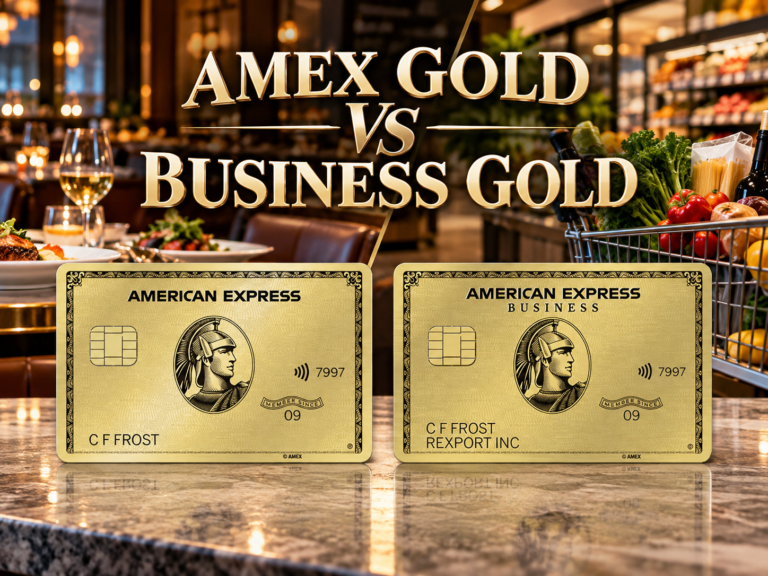
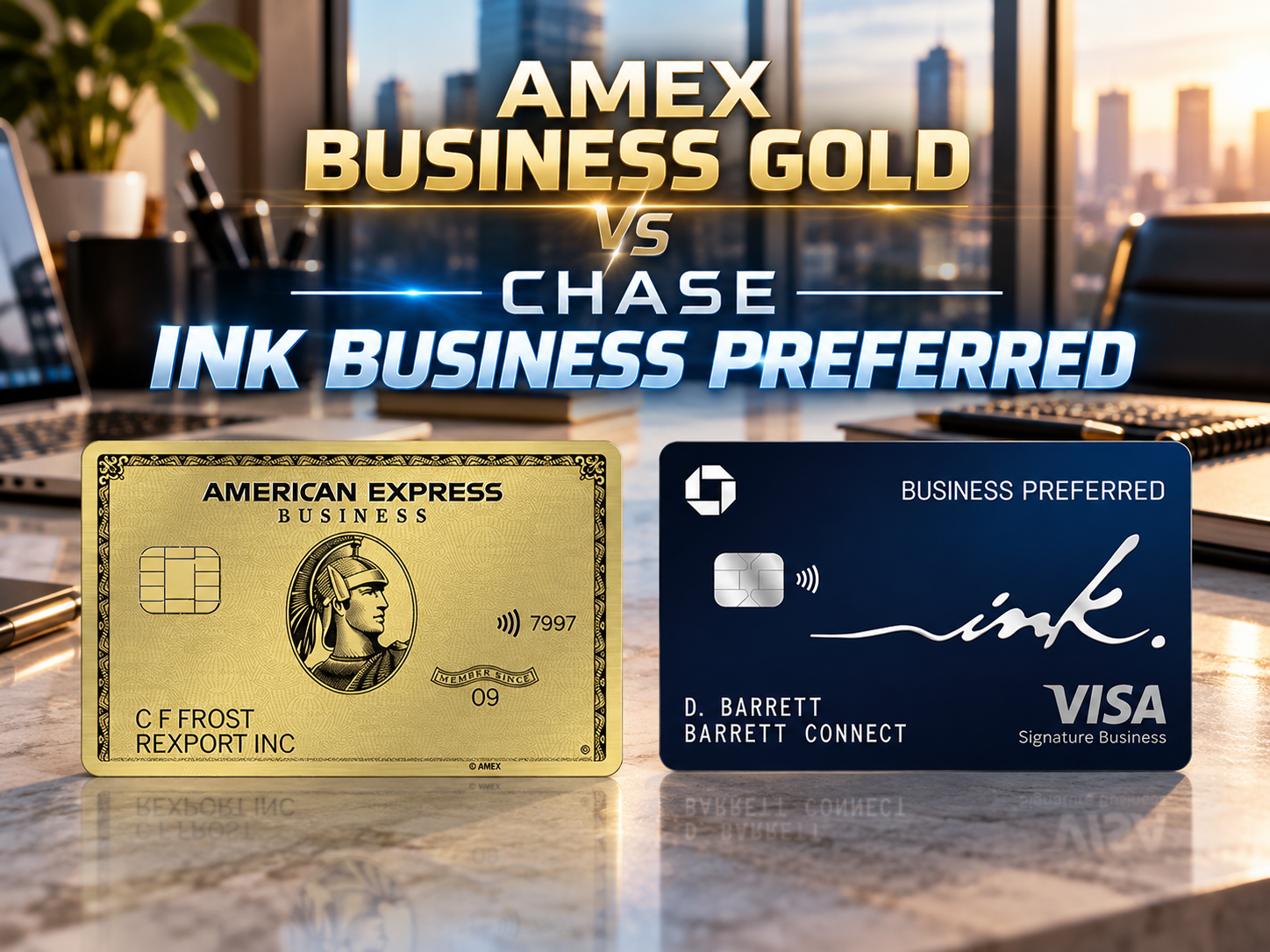

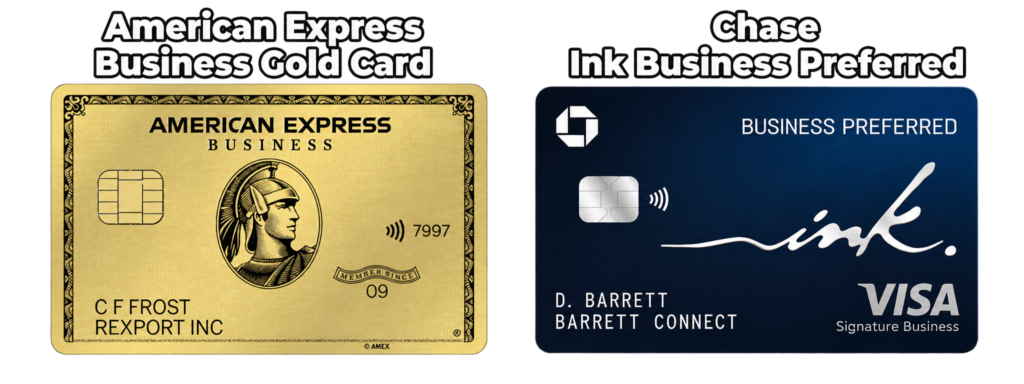
The American Express Business Gold Card and Chase Ink Business Preferred are both designed for businesses that want to earn transferable points, but they take very different approaches to business spending.
The American Express Business Gold Card automatically earns 4X Membership Rewards in the two eligible categories where your business spends the most each billing cycle. The Ink Business Preferred instead offers fixed 3X categories covering travel, shipping, internet and phone services, and select digital advertising.
The key comparison is therefore adaptive 4X business categories and business credits vs fixed 3X categories and the Ultimate Rewards ecosystem.
👉 American Express Business Gold Card Review
👉 Ink Business Preferred Review
⭐ Amex Business Gold vs Chase Ink Business Preferred: Full Comparison
| Feature | American Express Business Gold Card | Ink Business Preferred |
|---|---|---|
| Annual Fee | US$375 | US$95 |
| Points System | Membership Rewards | Ultimate Rewards |
| General Spending | 1X MR | 1X UR |
| Primary Bonus Categories | 4X in the top 2 eligible categories each billing cycle | 3X on travel, shipping, internet/cable/phone and select digital advertising |
| Bonus Spending Cap | $150,000 combined per calendar year | $150,000 combined per account anniversary year |
| Travel Portal | 3X on eligible flights and prepaid hotels through AmexTravel.com | Chase Travel |
| Primary Annual Credits | Flexible Business, ChatGPT Business, Squarespace, Walmart+ | — |
| Transfer Partners | ✓ | ✓ |
| Airport Lounge Access | — | — |
| Hotel Benefits | The Hotel Collection | — |
| Global Entry / TSA PreCheck | — | — |
| Foreign Transaction Fee | None | None |
💳 Adaptive 4X vs Fixed 3X Categories
The biggest difference between these cards is not simply 4X versus 3X. It is how the bonus categories are determined.
Business Gold: Automatic 4X on the Top Two Eligible Categories
Business Gold does not require you to manually select bonus categories.
Each billing cycle, Amex determines the two eligible categories where your business spent the most and awards 4X Membership Rewards on those purchases, subject to the applicable annual cap.
Eligible categories include:
- U.S. advertising in select media
- U.S. electronic goods retailers, software and cloud system providers
- U.S. restaurants
- U.S. gas stations
- Transit
- U.S. wireless telephone service providers
The important feature is that the two 4X categories can change automatically.
A business might spend most heavily on advertising and software one month, then restaurants and transit the next. Business Gold can adapt without requiring the cardholder to select new categories manually.
That makes the structure particularly relevant for businesses whose operating expenses change from month to month.
Ink Business Preferred: Predictable 3X Business Categories
Ink Business Preferred takes a more predictable approach.
Its core 3X categories include:
- Travel
- Shipping purchases
- Internet, cable and phone services
- Advertising purchases with social media sites and search engines
The categories remain fixed, making it easier to determine in advance which expenses should go on the card.
There is overlap between the two cards in areas such as advertising and telecommunications, but the coverage is not identical.
Business Gold expands into software, cloud services, restaurants, gas and transit. Ink Business Preferred instead adds two particularly important categories that Business Gold does not directly match: travel and shipping.
For e-commerce businesses, companies with substantial logistics expenses, and businesses with frequent employee travel, those categories can materially change the earning strategy.
💰 Business Credits and Annual Benefits
The two cards also take very different approaches to annual benefits.
Business Gold includes several business-oriented credits, including:
- Flexible Business Credit
- ChatGPT Business Credit
- Squarespace Credit
- Walmart+ Monthly Membership Credit
The face value of these benefits should not simply be added together and treated as cash.
Some credits have monthly restrictions, some require enrollment, and their practical value depends heavily on whether the business already pays for the eligible services.
For example, a credit tied to software or business services is much easier to use naturally when that service is already part of the company’s operating expenses.
Ink Business Preferred follows a much simpler model.
It does not rely on a large collection of annual credits to justify its carrying cost. Its value is concentrated in bonus categories, travel spending, transfer-partner access and a lower fixed carrying cost.
The practical question is therefore whether Business Gold’s credits overlap naturally with expenses the company would have paid anyway.
✈️ Business Travel Benefits
Both cards can play a role in business travel, but they do so differently.
Business Gold earns 3X Membership Rewards on eligible flights and prepaid hotels booked through AmexTravel.com.
It also provides access to The Hotel Collection. Eligible stays generally require a minimum two-night booking to receive the associated hotel benefits.
Ink Business Preferred instead places travel directly within its 3X bonus-category structure.
That means its travel earning is not built solely around a specific issuer travel portal. Eligible purchases that fall within Chase’s travel category can qualify for the card’s travel earning structure.
Shipping is also a 3X category, which can be especially relevant for e-commerce businesses or companies that regularly send products domestically or internationally.
Neither card is designed around premium airport benefits. There is no meaningful airport lounge program or Global Entry / TSA PreCheck credit driving this comparison.
Businesses looking primarily for Centurion Lounge access, Priority Pass, premium hotel status or similar benefits would be comparing a different class of business travel card.
🔄 Membership Rewards vs Ultimate Rewards
The other major difference is the points ecosystem.
👉 American Express Membership Rewards Guide
👉 Chase Ultimate Rewards Guide
Membership Rewards and Ultimate Rewards both provide access to multiple airline and hotel loyalty programs, with several important partners available through both ecosystems.
Shared airline partners include programs such as Aeroplan, Flying Blue, British Airways Executive Club, Singapore Airlines KrisFlyer and Virgin Atlantic Flying Club.
The more meaningful differences come from partners that are unique or particularly useful within each ecosystem.
Membership Rewards can transfer directly to ANA Mileage Club, which can be especially important for travelers who regularly redeem miles for ANA or other Star Alliance award flights.
That creates a direct path:
Business Spending → Membership Rewards → ANA Mileage Club
Ultimate Rewards, meanwhile, can transfer directly to United MileagePlus, which is not a direct Membership Rewards transfer partner.
Chase also has World of Hyatt, although the Hyatt transfer economics for Ink Business Preferred are changing.
The points comparison therefore depends less on whether MR or UR is universally “better” and more on which airline and hotel programs match the company’s actual travel and redemption strategy.
⚠️ Ink Business Preferred Hyatt Transfer Ratio Change
Ink Business Preferred has an important change affecting cardholders who use Ultimate Rewards for World of Hyatt.
Beginning October 1, 2026, transfers from Ink Business Preferred to World of Hyatt are scheduled to use a 4:3 ratio:
1,000 Ultimate Rewards Points → 750 World of Hyatt Points
As a result, the traditional assumption that Ink Business Preferred always provides 1:1 Hyatt transfers should no longer be treated as permanent.
This change affects the Hyatt transfer economics for the applicable card; it does not eliminate Ink Business Preferred’s broader access to eligible Ultimate Rewards airline and hotel transfer partners.
👤 Different Business Spending Profiles
High Digital Advertising Spend
Both cards can reward eligible digital advertising, but the mechanics differ.
Business Gold can award 4X on eligible U.S. advertising when it becomes one of the company’s top two qualifying categories for that billing cycle.
Ink Business Preferred provides a fixed 3X rate on eligible advertising purchases with social media sites and search engines.
The practical difference therefore depends not only on the multiplier, but also on how the advertising purchase is categorized and whether other expenses displace advertising from Business Gold’s top two categories.
High Software and Cloud Spending
This is a clear differentiator for Business Gold.
Eligible U.S. electronic goods, software and cloud system provider purchases can fall within its 4X structure, while Ink Business Preferred does not have a comparable software/cloud 3X category.
That can matter for SaaS businesses, technology companies, and companies with substantial recurring cloud-service expenses.
High Shipping and Business Travel Spend
This is where Ink Business Preferred has a distinct category advantage.
Travel and shipping are both built directly into its 3X structure, making it easier to capture rewards from logistics and business travel expenses without relying on those categories becoming the month’s highest spend.
Spending Categories Change Every Month
Businesses with highly variable expenses may benefit more from understanding Business Gold’s adaptive structure.
Advertising and software might dominate one billing cycle, while restaurants and transit become the largest eligible categories in another.
Businesses with highly predictable expenses, on the other hand, may find Ink Business Preferred’s fixed-category structure easier to plan around.
🏁 Bottom Line
The core difference between the American Express Business Gold Card and Ink Business Preferred is adaptive high-earning business categories versus predictable fixed business categories, combined with the differences between Membership Rewards and Ultimate Rewards.
Business Gold emphasizes automatically selected 4X categories, including software, cloud services and advertising, alongside several business-oriented credits. Ink Business Preferred focuses on a fixed set of 3X categories that includes travel, shipping, telecommunications and digital advertising, while providing access to the Ultimate Rewards transfer ecosystem.
The most useful way to compare them is therefore to start with the company’s actual operating expenses, then determine whether Membership Rewards or Ultimate Rewards better matches its eventual airline and hotel redemption strategy.