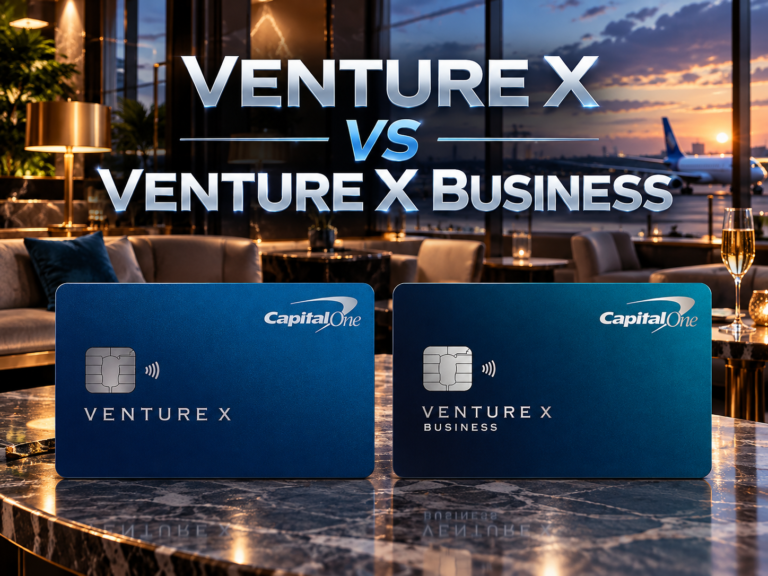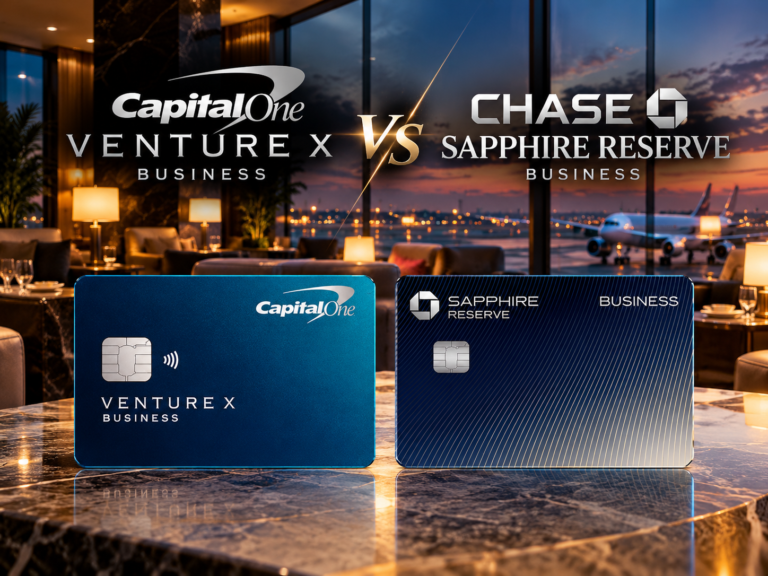


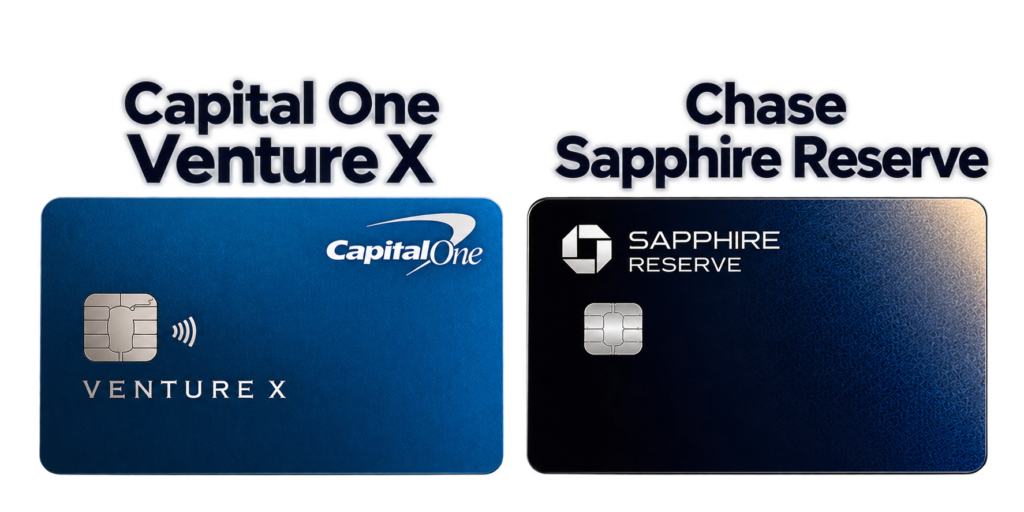
Capital One Venture X Rewards Credit Card and Chase Sapphire Reserve are both premium U.S. travel credit cards, but they take very different approaches.
Venture X focuses on simplicity and strong everyday rewards, offering 2X Capital One Miles on general purchases along with Capital One Travel benefits, an annual travel credit, anniversary miles, and airport lounge access.
Chase Sapphire Reserve is built around a broader premium travel ecosystem, combining bonus rewards on travel and dining with Chase Travel, The Edit, Sapphire Lounge access, and Chase Ultimate Rewards.
👉 Capital One Venture X Rewards Credit Card Review
👉 Chase Sapphire Reserve Review
⭐ Capital One Venture X vs Chase Sapphire Reserve
| Benefit | Capital One Venture X | Chase Sapphire Reserve |
|---|---|---|
| Annual Fee | US$395 | US$795 |
| Rewards Program | Capital One Miles | Ultimate Rewards |
| General Purchases | 2X Miles | 1X UR |
| Flights Booked Direct | 2X Miles | 4X UR |
| Hotels Booked Direct | 2X Miles | 4X UR |
| Dining | 2X Miles | 3X UR |
| Travel Portal | 10X hotels & rental cars; 5X flights | 8X through Chase Travel |
| Annual Travel Credit | $300 through Capital One Travel | $300 Travel Credit |
| Anniversary Bonus | 10,000 Miles | — |
| Luxury Hotel Program | Premier Collection | The Edit |
| Capital One Lounge | ✓ | — |
| Capital One Landing | ✓ | — |
| Chase Sapphire Lounge | — | ✓ |
| Priority Pass | ✓ | ✓ |
| Global Entry / TSA PreCheck | ✓ | ✓ |
| Airline & Hotel Transfers | ✓ | ✓ |
| Foreign Transaction Fee | None | None |
The fundamental difference between these two cards is straightforward:
Venture X → 2X everyday spending + simple annual benefits
Sapphire Reserve → stronger travel and dining rewards + a broader premium travel ecosystem
💰 Annual Credits and Long-Term Value
Both cards offer annual travel credits, but they work very differently.
Capital One Venture X
Venture X keeps its annual benefits relatively simple.
The $300 annual travel credit must be used through Capital One Travel. Starting with the first account anniversary, cardholders also receive 10,000 anniversary miles each year.
This structure means there are relatively few recurring credits to track.
The main limitation is that the travel credit is tied to Capital One Travel. Travelers who prefer booking directly with airlines and hotels may find the Sapphire Reserve travel credit more flexible.
Chase Sapphire Reserve
The Sapphire Reserve $300 Travel Credit applies to a much broader range of eligible travel purchases and does not require booking through Chase Travel.
The card also includes additional benefits and credits tied to The Edit, dining, StubHub and viagogo, Lyft, Peloton, DoorDash, and other partners.
The difference can therefore be summarized as:
Venture X → fewer credits, easier to manage
Sapphire Reserve → more credits and greater flexibility
When comparing the two, it is better not to treat the maximum face value of every credit as cash. What matters is whether you would naturally use those benefits anyway.
💳 Everyday Spending: Venture X Keeps It Simple
One of the biggest advantages of Venture X is its straightforward earning structure.
General purchases earn:
$1 = 2 Capital One Miles
There is no need to keep track of whether a purchase falls into a specific bonus category.
Sapphire Reserve earns only 1X Ultimate Rewards on general purchases, so everyday spending is not the card’s primary strength.
A simple way to divide spending between the two cards is:
Non-bonus spending → Venture X
Travel and dining bonus categories → Sapphire Reserve
✈️ Travel and Dining: Sapphire Reserve Rewards Direct Bookings
Both cards offer elevated rewards through their respective travel portals, but the more meaningful difference appears when you book outside the portal.
Venture X maintains its standard 2X earning rate on direct travel purchases.
Sapphire Reserve offers bonus rewards on flights booked directly with airlines, hotels booked directly, and dining.
That gives Sapphire Reserve an advantage for travelers who prefer booking directly instead of using a travel portal.
A practical division looks like this:
General purchases → Venture X
Flights booked directly → Sapphire Reserve
Hotels booked directly → Sapphire Reserve
Dining → Sapphire Reserve
Capital One Travel → Venture X
Chase Travel → Sapphire Reserve
Venture X is built around simple earning, while Sapphire Reserve puts more emphasis on travel and dining bonus categories.
🛋️ Capital One Lounge vs Chase Sapphire Lounge
Both cards include Priority Pass access, but their proprietary airport lounge networks are what really distinguish them.
| Lounge Access | Venture X | Sapphire Reserve |
|---|---|---|
| Capital One Lounge | ✓ | — |
| Capital One Landing | ✓ | — |
| Chase Sapphire Lounge | — | ✓ |
| Priority Pass | ✓ | ✓ |
| Air Canada Maple Leaf Lounge / Café | — | ✓ |
Venture X provides access to Capital One Lounges and Capital One Landings.
Sapphire Reserve centers its lounge offering around Chase Sapphire Lounge by The Club, supplemented by Priority Pass and eligible Air Canada Maple Leaf Lounges and Cafés.
Venture X Guest Policy
Venture X lounge guest rules changed in 2026.
The primary cardholder continues to receive eligible lounge access, but guests are no longer universally complimentary.
Adult guests at Capital One Lounges cost $45 per person per visit, while Priority Pass guests cost $35 per person per visit.
Cardholders who meet the required $75,000 calendar-year spending threshold can unlock complimentary access for up to two guests at Capital One Lounges.
Eligible Sapphire Reserve cardholders, meanwhile, can bring up to two guests into Sapphire Lounges.
For solo travelers, the difference may be relatively small. For travelers who regularly visit lounges with family or friends, the guest policy can become a major consideration.
🏨 Premier Collection vs The Edit
Capital One and Chase each operate a luxury hotel program:
Capital One → Premier Collection
Chase → The Edit
Both can provide additional benefits at participating luxury hotels, such as breakfast, property credits, room upgrades when available, early check-in, and late checkout.
Premier Collection is integrated into the broader Capital One premium travel ecosystem.
The Edit combines luxury hotel benefits with a separate annual credit available to Sapphire Reserve cardholders, which can add value for travelers who already stay at participating properties.
If most of your hotel stays are with Marriott, Hilton, Hyatt, or another major hotel loyalty program, however, it is also worth considering how portal bookings may affect the elite benefits and hotel points you normally receive from booking directly.
🔄 Capital One Miles vs Ultimate Rewards
For travelers focused on airline miles, the transfer partners available through Capital One Miles and Chase Ultimate Rewards are one of the most important long-term differences between these cards.
| Transfer Partner | Capital One Miles | Ultimate Rewards |
|---|---|---|
| Air Canada Aeroplan | ✓ | ✓ |
| Air France-KLM Flying Blue | ✓ | ✓ |
| British Airways Club | ✓ | ✓ |
| EVA Air Infinity MileageLands | ✓ | — |
| JAL Mileage Bank | ✓ | — |
| United MileagePlus | — | ✓ |
| World of Hyatt | — | ✓ |
The two programs share several useful airline partners, including Aeroplan, Flying Blue, and British Airways.
The more important differences are their unique transfer partners.
Capital One Miles
Capital One Miles can transfer to programs including EVA Air Infinity MileageLands and JAL Mileage Bank.
That gives Capital One an interesting position for travelers who frequently use Asian airline loyalty programs.
Ultimate Rewards
Ultimate Rewards offers access to United MileagePlus and World of Hyatt.
World of Hyatt is particularly important because it gives Ultimate Rewards a strong hotel redemption option in addition to its airline transfer partners.
The distinction can be summarized as:
EVA Air / JAL → Capital One Miles
United / Hyatt → Ultimate Rewards
👉 Chase Ultimate Rewards Guide
👤 Which Card Better Fits Your Spending?
| Spending / Travel Style | Better Fit | Main Reason |
|---|---|---|
| Heavy general spending | Venture X | Flat 2X earning |
| Prefer simple rewards | Venture X | No bonus categories to track |
| Book flights directly | Sapphire Reserve | Travel bonus category |
| Book hotels directly | Sapphire Reserve | Travel bonus category |
| Spend heavily on dining | Sapphire Reserve | Dining bonus category |
| Use Capital One Travel | Venture X | Elevated portal rewards |
| Use Chase Travel | Sapphire Reserve | Elevated portal rewards |
| Visit Capital One Lounges | Venture X | Capital One lounge network |
| Visit Sapphire Lounges | Sapphire Reserve | Chase lounge network |
| Frequently bring lounge guests | Sapphire Reserve has a more straightforward structure | Sapphire Lounge guest policy |
| Prefer fewer credits to track | Venture X | Simpler annual benefits |
| Stay at luxury hotels | Both | Premier Collection / The Edit |
| Transfer to EVA Air / JAL | Venture X | Capital One transfer partners |
| Transfer to United / Hyatt | Sapphire Reserve | Ultimate Rewards transfer partners |
This is why comparing the cards solely by annual fee does not tell the full story.
Venture X is designed to provide premium travel benefits with a relatively simple rewards structure, while Sapphire Reserve combines more bonus categories, credits, and travel benefits into a broader ecosystem.
💳 Can You Have Venture X and Sapphire Reserve Together?
Yes. In fact, the cards can serve very different roles.
Venture X
Use it for general 2X spending, Capital One Travel, Capital One Lounge access, and building a balance of Capital One Miles.
Sapphire Reserve
Use it for travel and dining bonus categories, Chase Travel, Sapphire Lounge access, and earning Ultimate Rewards.
Holding both also gives you access to two transferable rewards currencies:
Capital One Miles + Ultimate Rewards
When award availability appears, you can choose which points to transfer based on the airline program you need.
However, there is meaningful overlap between the cards, including travel portals, Priority Pass, and luxury hotel programs.
The key question is therefore not whether you can hold both cards, but whether you can naturally use enough of both cards’ benefits to justify keeping them.
📌 Capital One Venture X vs Chase Sapphire Reserve: Bottom Line
| Capital One Venture X | Chase Sapphire Reserve | |
|---|---|---|
| Core Positioning | Simple Premium Travel | Premium Travel Ecosystem |
| Everyday Spending | Major Strength | Not the primary focus |
| Travel & Dining | Simple flat earning | Broader bonus categories |
| Lounge Network | Capital One + Priority Pass | Sapphire + Priority Pass |
| Annual Benefits | Concentrated and simple | More extensive |
| Luxury Hotels | Premier Collection | The Edit |
| Rewards Currency | Capital One Miles | Ultimate Rewards |
| Distinctive Partners | EVA Air / JAL | United / Hyatt |
Capital One Venture X stands out for simplicity: 2X miles on general purchases, an annual travel credit, anniversary miles, Capital One Lounge access, and transferable Capital One Miles.
Chase Sapphire Reserve builds a broader premium travel ecosystem around travel and dining bonus categories, Chase Travel, The Edit, Sapphire Lounges, and Ultimate Rewards.
The simplest way to think about the two cards is: