


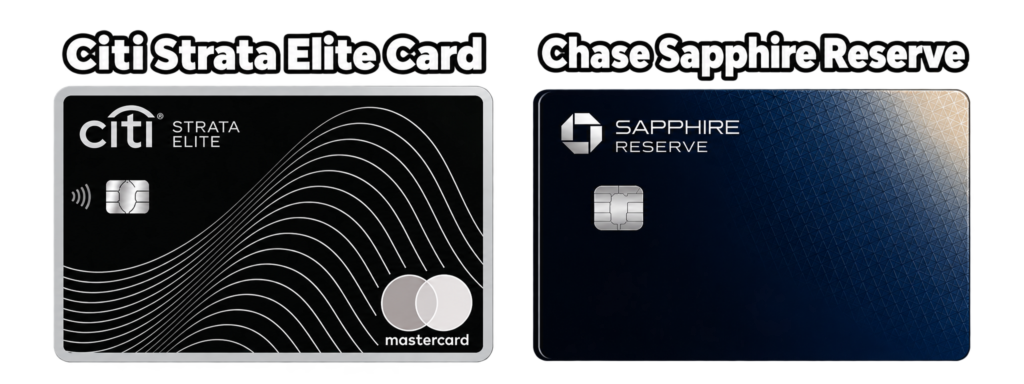
The Citi Strata Elite Card and Chase Sapphire Reserve are both premium U.S. travel cards with transferable points, airport lounge access, and substantial annual benefits, but they approach premium travel very differently.
Strata Elite emphasizes high Citi Travel earning rates, 1.5X on general purchases, Citi ThankYou Points, and Admirals Club passes. Sapphire Reserve puts more weight on direct flight and hotel bookings, Chase Travel, Sapphire Lounges, and Ultimate Rewards.
The key comparison is therefore not simply which card offers more benefits. It is how you book travel, which airport lounges you use, and whether Citi ThankYou Points or Chase Ultimate Rewards better fits your award-travel strategy.
👉 Citi Strata Elite Card Full Review
👉 Chase Sapphire Reserve Full Review
⭐ Citi Strata Elite vs Chase Sapphire Reserve: Full Comparison
| Category | Citi Strata Elite Card | Chase Sapphire Reserve |
|---|---|---|
| Annual Fee | US$595 | US$795 |
| Points Program | Citi ThankYou Points | Chase Ultimate Rewards |
| General Purchases | 1.5X | 1X |
| Dining | 3X / 6X during Citi Nights | 3X |
| Flights Booked Direct | 1.5X | 4X |
| Hotels Booked Direct | 1.5X | 4X |
| Travel Portal | 12X Hotels / Car Rentals / Attractions; 6X Flights | 8X Chase Travel |
| Main Travel Credit | Up to $300 Annual Hotel Benefit | Up to $300 Annual Travel Credit |
| Other Major Credits | Splurge Credit, Blacklane Credit | The Edit, Dining, StubHub, DoorDash and others |
| Airport Lounge Access | Priority Pass Select + 4 Admirals Club Passes per calendar year | Sapphire Lounge + Priority Pass Select + eligible Air Canada Lounges |
| Premium Hotel Program | The Reserve by Citi Travel | The Edit by Chase Travel |
| Global Entry / TSA PreCheck | Available | Available; NEXUS also eligible |
| Foreign Transaction Fee | None | None |
💳 Portal Rewards vs Direct Travel Spending
The biggest strength of Strata Elite’s rewards structure is Citi Travel.
Hotels, rental cars, and attractions booked through the portal earn its highest rate, while flights booked through Citi Travel also receive an elevated return. That can generate ThankYou Points quickly for travelers who already use Citi’s booking platform.
Outside the portal, however, the structure changes.
Dining remains a useful category, and Citi Nights can increase restaurant earning during eligible periods. General purchases also earn 1.5X, giving Strata Elite a stronger base rate than Sapphire Reserve for uncategorized spending.
Sapphire Reserve takes a different approach.
Its strongest feature for many frequent travelers is elevated earning on flights and hotels booked directly, rather than requiring those purchases to go through Chase Travel.
The distinction can be summarized as:
Strata Elite → strongest emphasis on Citi Travel
Sapphire Reserve → Chase Travel + strong direct flight and hotel earning
Direct hotel bookings can be particularly important for travelers with hotel elite status. Booking directly can make it easier to retain hotel points, elite-night credits, and status benefits instead of choosing a portal solely for a higher credit-card multiplier.
💰 Credits and Annual Benefits
Both cards offer substantial annual benefits, but the usability of those credits differs.
Strata Elite’s Annual Hotel Benefit is tied to an eligible hotel stay booked through Citi Travel. The Splurge Credit is limited to participating brands, while the Blacklane Credit is tied specifically to Blacklane and divided into separate usage periods.
That means extracting value from Strata Elite requires understanding where and how each benefit can be used.
Sapphire Reserve’s core Travel Credit is broader. Eligible travel purchases can trigger the credit without requiring all travel to be booked through Chase Travel.
Its other benefits are more fragmented.
The Edit, dining, StubHub, DoorDash, and other benefits each come with their own merchants, booking requirements, or usage periods. Some are divided into semiannual or monthly allotments.
The practical difference is:
Strata Elite → Hotel / Splurge / Blacklane-focused credits
Sapphire Reserve → broader core Travel Credit + a larger collection of separate lifestyle and travel credits
For either card, adding the face value of every credit together does not represent its real value. The more useful question is how much of those benefits replace spending you would have made anyway.
✈️ Two Different Airport Lounge Strategies
Both cards include Priority Pass Select, but their distinctive lounge benefits are different.
Strata Elite adds four Admirals Club Citi Strata Elite Passes per calendar year, giving the card a particularly useful angle for eligible American Airlines travelers.
Sapphire Reserve instead centers its lounge proposition around the growing Chase Sapphire Lounge by The Club network, alongside Priority Pass and access to eligible Air Canada Maple Leaf Lounges and Cafés.
That creates two different ecosystems:
Strata Elite → Priority Pass + Admirals Club Passes
Sapphire Reserve → Priority Pass + Sapphire Lounge Network + eligible Air Canada Lounges
For someone who regularly flies American Airlines, the Admirals Club passes can fill a specific role. For travelers frequently passing through airports with Sapphire Lounges, Chase’s proprietary lounge network creates a different type of benefit.
Premium Hotel Programs
Strata Elite provides access to The Reserve by Citi Travel, while Sapphire Reserve uses The Edit by Chase Travel.
Both programs are designed around premium hotel bookings and additional on-property benefits, but Sapphire Reserve also integrates The Edit into its broader annual credit structure.
Sapphire Reserve’s elevated rewards on hotels booked directly also create another option for travelers who would rather book with the hotel chain and preserve their normal elite-status benefits.
🔄 Citi ThankYou Points vs Chase Ultimate Rewards
The long-term difference between these cards goes beyond travel benefits because they earn completely different transferable currencies.
👉 Citi ThankYou Points Complete Guide
👉 Chase Ultimate Rewards Complete Guide
The two programs share several useful airline partners, including Air Canada Aeroplan, Flying Blue, Singapore Airlines KrisFlyer, and Virgin Atlantic. As a result, many Star Alliance, SkyTeam, and partner-award strategies can be accessed from either ecosystem.
The more important differences are the partners that are unique or especially distinctive to each program.
Citi: American Airlines, JAL, and EVA Air
Citi ThankYou Points provides direct access to several particularly notable airline programs, including American Airlines AAdvantage, Japan Airlines Mileage Bank, and EVA Air Infinity MileageLands.
AAdvantage gives Citi a distinctive path into American Airlines and oneworld awards, while JAL and EVA Air add useful options for travel between the U.S. and Asia.
This makes Citi’s transfer ecosystem especially interesting for travelers who actively use oneworld programs or frequently travel to Japan and Taiwan.
Chase: United and Hyatt
Ultimate Rewards has a different set of strengths, particularly United MileagePlus and World of Hyatt.
United provides a direct path into MileagePlus and Star Alliance redemptions, while Hyatt remains one of the most distinctive hotel partners in the Chase ecosystem.
For eligible Sapphire Reserve cardholders, the current Ultimate Rewards structure also preserves the more favorable Hyatt transfer treatment available to qualifying Chase cardholders.
The ecosystems can therefore be viewed as:
Citi TYP → American Airlines / JAL / EVA Air
Chase UR → United / Hyatt
For award travel, the better approach is generally to find the award space first and then determine which transferable currency provides access to the mileage program you need.
⚠️ Citi Nights Has a Specific Time Window
Strata Elite’s elevated Citi Nights restaurant earning does not apply to every dining purchase.
Citi Nights applies to eligible restaurant purchases on Friday and Saturday from 6 p.m. to 6 a.m. Eastern Time. Restaurant purchases outside the eligible window earn the card’s standard dining rate.
That distinction matters because Strata Elite should not be treated as a card that earns its highest restaurant rate at all times.
Sapphire Reserve’s dining structure is simpler and does not require purchases to fall within a Citi Nights-style time window.
For frequent restaurant spending, the practical question is therefore not only the maximum multiplier, but how often your actual dining habits qualify for Citi Nights.
👤 Where the Two Cards Differ Most
Travelers who frequently book through Citi Travel can make greater use of Strata Elite’s portal-focused earning structure, while its 1.5X base rate also covers purchases that do not fall into a bonus category.
Travelers who prefer booking directly with airlines and hotels encounter a different structure with Sapphire Reserve. This can be particularly relevant for frequent hotel guests who want to preserve hotel points, elite-night credits, and status recognition.
Lounge habits also matter. American Airlines travelers may find specific utility in Strata Elite’s Admirals Club passes, while frequent visitors to airports with Sapphire Lounges have access to a different proprietary network through Sapphire Reserve.
Finally, the points ecosystems can shape the cards’ roles in an award-travel strategy. ThankYou Points offers direct access to programs such as AAdvantage, JAL, and EVA Air, while Ultimate Rewards provides distinctive access to United and Hyatt.
🏁 Citi Strata Elite vs Chase Sapphire Reserve: Conclusion
The fundamental difference between the Citi Strata Elite Card and Chase Sapphire Reserve is portal-focused premium travel versus a broader mix of direct travel earning and Chase’s own premium travel ecosystem.
Strata Elite emphasizes Citi Travel, ThankYou Points, Admirals Club passes, and Citi-specific annual benefits. Sapphire Reserve combines direct travel earning, Chase Travel, the Sapphire Lounge network, and Ultimate Rewards.
The practical distinction therefore comes down to how you book travel, which lounges you actually use, and which airline or hotel programs you ultimately want your transferable points to reach.